SEO Best Practices for Blogs in 2026: A Practical Guide
A practical 2026 guide to blog SEO: search intent, titles, internal links, structured data, AI search, technical SEO, content updates, and measurement.
8 min read
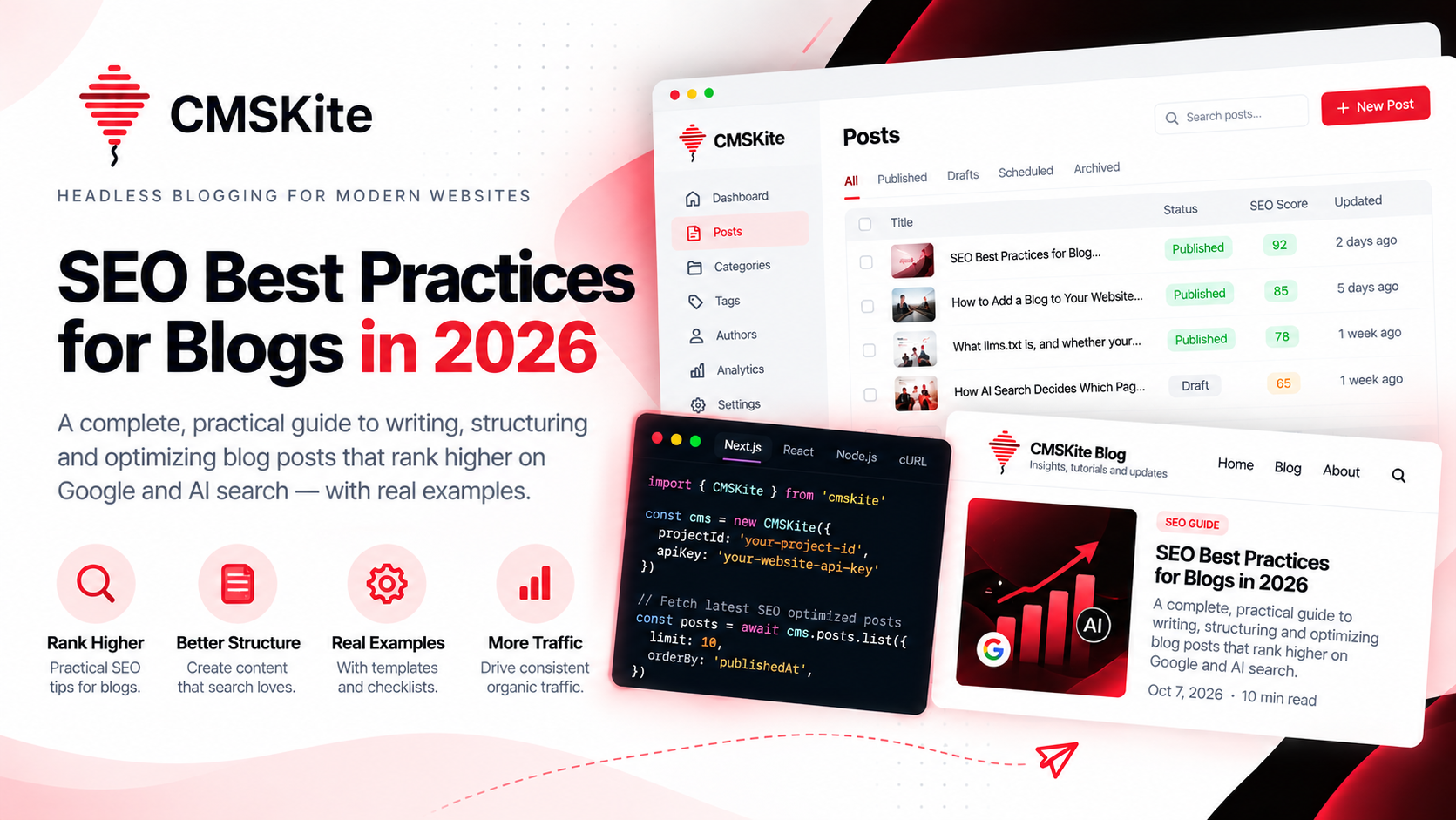
SEO Best Practices for Blogs in 2026: A Practical Guide
Publishing a blog post is easy. Getting the right people to discover it is the harder part.
The best SEO practices for blogs in 2026 are not about stuffing a page with keywords or chasing a secret ranking trick. They are about creating useful content, making the page easy for search engines to understand, and building a website structure that helps both people and search systems discover the right information.
Google's current guidance continues to emphasize helpful, reliable, people-first content, while its guidance for AI Overviews and AI Mode says the same foundational SEO practices remain important for appearing in generative search experiences. See Google's current guidance on helpful content, AI features, and generative AI search.
1. Start with search intent for SEO best practices for blogs
Before writing anything, understand what the reader actually wants.
A keyword is only useful when you understand the intent behind it.
For example, someone searching for:
- what is a headless CMS is probably learning.
- headless CMS for Next.js is probably evaluating a solution.
- best headless CMS for SaaS has stronger commercial intent.
- CMSKite pricing is a product-specific query.
Your article should satisfy the intent behind the query instead of simply repeating the keyword.
A useful question is: What would make the person leave this page feeling that their question was completely answered?
That should shape the structure, examples, depth, and call to action.
2. Choose one primary keyword
Every article should have a clear primary topic.
For this article, the primary keyword is SEO best practices for blogs.
You can support it with related terms such as:
- blog SEO
- SEO tips for bloggers
- Google Search
- AI search
- meta title
- meta description
- internal linking
- structured data
- search intent
- content optimization
The goal is not to use every variation repeatedly.
Google's own guidance explains that its systems can understand how a page relates to many queries without requiring you to include every possible keyword variation.
Write naturally first and make the main topic obvious.
3. Write a title that is clear and useful
Your title is one of the most visible parts of a search result.
A strong SEO title should be specific, easy to understand, unique, accurate, and useful to the reader.
For example:
SEO Best Practices for Blogs in 2026: A Practical Guide
is clearer than:
10 Things You Need to Know About Blogging
The first title tells the reader exactly what they will get.
Google's SEO documentation recommends clear, concise, descriptive titles rather than titles written only to manipulate rankings.
4. Write a useful meta description
A meta description is not a magic ranking switch, but it can influence how your page is represented in search.
Treat it as a short sales pitch for the article.
Explain:
- What the article covers.
- Who it is for.
- Why it is worth opening.
For example:
Learn the practical SEO best practices for blogs in 2026, from search intent and titles to internal links, structured data, AI search, and content updates.
The description should match the actual article.
Google notes that snippets are often generated from page content and may sometimes use the meta description, so the page itself needs to clearly communicate the topic.
5. Create people-first content
This is probably the most important rule.
Do not write an article only because a keyword has search volume.
Write it because the article solves a real problem.
Useful blog content usually has:
- A clear purpose
- Original explanations
- Practical examples
- Useful structure
- Accurate information
- Clear language
- A strong answer to the reader's question
Google's guidance continues to emphasize helpful, reliable, people-first content rather than content created primarily to attract search traffic.
That matters even more as search interfaces evolve.
6. Structure the article for humans first
A good article should be easy to scan.
Use:
- One clear H1
- Descriptive H2 sections
- Short paragraphs
- Lists where they improve readability
- Examples
- Logical progression
- Clear conclusions
Do not turn every sentence into a heading.
The goal is to help readers find the section they need quickly.
Readable structure also makes it easier for search systems to understand the relationship between topics on the page.
7. Make the introduction answer the query quickly
The first few paragraphs matter.
Do not spend five paragraphs explaining why you decided to write the article.
Tell the reader what they are going to learn.
For a keyword like SEO best practices for blogs, the introduction should quickly establish:
- What modern blog SEO involves.
- What has changed.
- What has not changed.
- What the reader will learn.
This improves the user experience and naturally places the primary topic in context.
8. Use internal links strategically
A blog should not be a collection of isolated pages.
Connect related articles.
For example, a post about blog SEO can naturally link to adding a blog to a website without WordPress and building a blog in Next.js with the CMSKite SDK.
Internal links help readers discover related information and help search engines understand how pages on your site are connected.
Google explicitly recommends linking to relevant resources and using descriptive anchor text where it helps users and search engines understand the destination.
9. Optimize images, not just text
A blog page is not only a text document.
Useful images can improve understanding, presentation, and engagement.
Use relevant images when they add value and give them meaningful alt text.
The important part is context.
Do not add decorative images just to increase the number of images on the page.
Google's current guidance for AI features also recommends supporting textual content with high-quality images and videos when appropriate.
10. Use structured data when it makes sense
Structured data can help Google understand what a page represents.
For blog content, Article or BlogPosting structured data can communicate information such as the headline, image, dates, and author. Google says this can help it understand article pages and potentially present better title, image, and date information in search experiences.
Structured data should match what is actually visible on the page.
It is not a replacement for good content.
11. Keep technical SEO clean
A great article cannot perform well if search engines cannot access or understand the page.
Check the basics:
- The page can be crawled.
- The page can be indexed.
- The URL is clean.
- The page has a descriptive title.
- The content is available as text.
- Important resources are not accidentally blocked.
- Canonical URLs are correct.
- Mobile and desktop experiences both work.
- The page loads efficiently.
Google's developer guidance highlights descriptive titles and meta descriptions, semantic HTML, accessible text content, security, performance, and mobile compatibility as important technical foundations.
12. Optimize for AI search without chasing gimmicks
AI search has changed how users discover information, but the fundamentals are surprisingly familiar.
Google's current documentation says there are no special technical requirements or separate AI SEO markup required for AI Overviews or AI Mode. The same fundamentals still matter: indexed content, strong technical SEO, useful content, internal links, accessible text, and high-quality media.
That means you should not build your strategy around gimmicks such as:
- Writing hidden AI-only text
- Creating fake AI-only files
- Repeating a keyword unnaturally
- Producing dozens of thin pages
Instead, make the page genuinely useful.
A clear article with strong structure is easier for both people and modern search systems to understand.
13. Build topical depth instead of publishing random posts
One article rarely establishes a strong topic by itself.
Imagine your website is about modern web content infrastructure.
Instead of publishing random articles, build a connected content cluster:
Headless CMS → Headless blog → Blog API → Next.js integration → SEO → Analytics → Content strategy
Each article answers a different question while strengthening the overall topic.
This is much more useful than publishing twenty unrelated posts.
14. Update content that already has potential
SEO is not always about publishing something new.
Some of your best opportunities are already sitting on your website.
Review older posts and look for:
- Declining traffic
- Outdated information
- Missing sections
- Weak titles
- Missing internal links
- Poor images
- Old examples
- New search intent
Refreshing a useful article can be more valuable than creating another page that covers the same topic.
Google's SEO guidance encourages keeping content useful and up to date when needed.
15. Measure what actually happens
Do not judge SEO only by rankings.
Look at:
- Impressions
- Clicks
- Click-through rate
- Organic traffic
- Engaged readers
- Top-performing articles
- Queries bringing users to the site
- Pages that lead users deeper into the website
Google Search Console is built specifically to help site owners understand search performance, while CMS-level analytics can help connect content with actual readership.
As search evolves, Google has also introduced reporting around visibility in generative AI features, making it increasingly useful to measure more than classic blue-link traffic.
A simple blog SEO checklist
Before publishing, ask:
Content
- Does this article answer a real question?
- Is it original and useful?
- Does it satisfy the search intent?
On-page SEO
- Is there one clear primary topic?
- Is the title descriptive?
- Is the meta description useful?
- Does the main topic appear naturally in the introduction and headings?
Structure
- Are the sections easy to scan?
- Are there useful internal links?
- Does the article have a logical flow?
Technical
- Is the URL clean?
- Is the page indexable?
- Is the canonical correct?
- Are important images optimized and described?
Measurement
- Can you track search performance?
- Can you see which content gets read?
- Do you have a plan to update the article later?
How CMSKite fits into this workflow
SEO works better when it is part of publishing rather than a task you remember after writing.
CMSKite brings content management, SEO fields, publishing, API delivery, and analytics into one workflow.
You can write the article, manage its metadata, publish it, deliver it to your own frontend, and then measure how the content performs.
That is especially useful when you are building with a custom frontend and want the content layer to remain independent.
For developers who want a deeper technical introduction, read the Headless Blog API guide.
Final thoughts
The best SEO practices for blogs in 2026 are less about finding a secret and more about getting the fundamentals right consistently.
Understand search intent.
Create genuinely useful content.
Write clear titles and descriptions.
Build strong internal links.
Keep technical SEO clean.
Use structured data where appropriate.
Optimize for real readers first.
Measure the results.
And as AI-powered search continues to evolve, remember the most important principle: create content that is worth finding in the first place.
That is a much stronger long-term SEO strategy than trying to outsmart the search engine.
- #seo
- #blog-seo
- #content-strategy
- #search-engine-optimization
- #ai-search
- #technical-seo
- #content-marketing
- #cmskite