Compare · Medium and Substack
Medium, Substack or your own website? Follow the reader.
Medium and Substack are places to build a readership: reading platforms with their own apps, and on Substack an email list that is yours. Even with your own domain connected, a post there is a Medium or Substack page, not part of your business website. CMSKite puts posts on the website you already have, so a reader who arrives from Google is one click from what you sell.
The short answer
- Choose Substack if you want an email newsletter and readers who pay you directly. Publishing is free; Substack keeps 10% of paid subscriptions.
- Choose Medium if you want to reach the people reading on Medium, or earn from member reading through its Partner Program.
- Choose CMSKite if the blog is there to bring customers to your business: posts appear on your own website, in its design, next to your products, prices and contact details.
Whose website the reader lands on
On Medium, posts live at medium.com unless you are a paying member and connect a domain such as yourbusiness.com or a subdomain such as blog.yourbusiness.com. Medium does not allow a folder such as yourbusiness.com/blog. On Substack, a custom domain is a one-time $50 fee, and Substack recommends a subdomain such as www.yourdomain.com. Either way the address points at the whole publication, so it cannot be one page inside a website you already have.
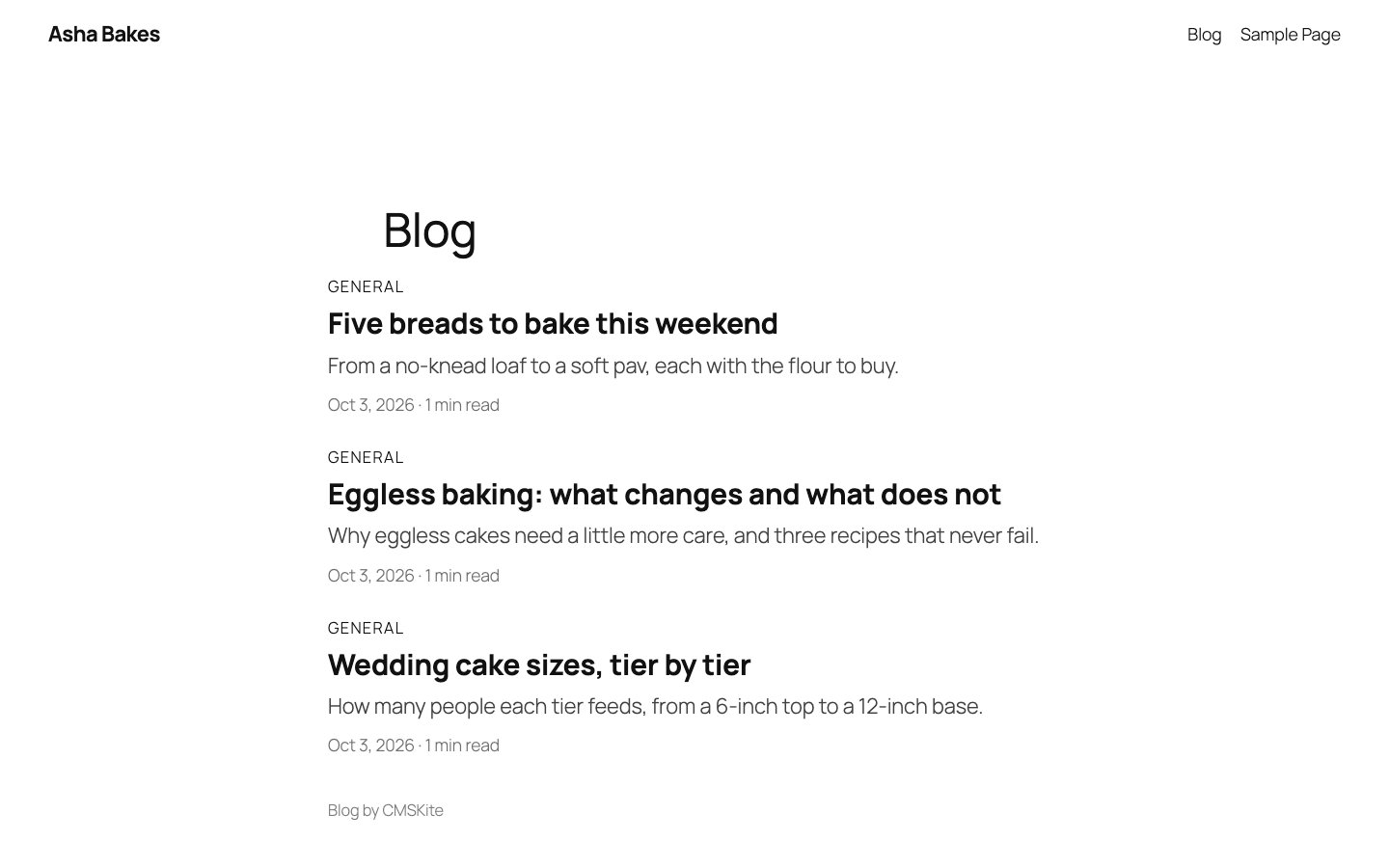
CMSKite works the other way round. Your website stays where it is, and two lines on its Blog page bring the posts in, under your own header and menu. Each post opens at an address on your site, with its own title, description and canonical link, and a sitemap lists it. A reader who finds a post on Google is on your site, one click from booking, buying or getting in touch.
Side by side
| Medium | Substack | CMSKite | |
|---|---|---|---|
| Cost to publish | Free to write. Membership is $5 a month or $50 a year. | Free, however many subscribers you have. | A free plan with no card; paid plans below. |
| Your own domain | Members only: a domain or subdomain, not a folder such as /blog. | A one-time $50 fee; a domain or subdomain you own. | Posts show on a page of your own website through the embed. The free blog link stays at cmskite.com. |
| People can subscribe to you and get a preview of each story by email, linking back to Medium. | Posts go to the web, by email and to the Substack app by default. Your subscriber list can be exported. | None. CMSKite does not email your readers. | |
| Getting paid by readers | Partner Program: members-only stories earn from member reading. It needs an active membership. | Paid subscriptions. Substack keeps 10%, and Stripe charges its own fees. | None. No paywall or subscriptions. |
| Reader replies | Responses under stories. | Comments, likes and restacks, which you can turn on or off. | None. |
| Taking your posts out | Settings → Security and apps → Download your information: your stories as HTML files in a zip. | Settings → Exports: a zip of your posts, subscriber list and statistics. | No export button. Every post can be read through the API, in the format it was written (Markdown, HTML or plain text). |
When Medium or Substack is the better choice
- You are building a personal readership. Both are reading platforms with their own apps and readers. CMSKite brings no audience of its own; readers come from search and from links you share.
- You want an email list. Substack sends every post by email and lets you export the list. CMSKite sends nothing by email.
- You want readers to pay you. Substack’s paid subscriptions or Medium’s Partner Program. CMSKite has no paywall.
- You have no website and do not want one. A Substack publication or a Medium profile is a complete home. CMSKite’s free blog link is one too, but without a newsletter, comments or a network of readers.
When CMSKite is the better choice
- The point of the blog is customers. Posts sit inside your own website, where the reader can buy, book or call. Add a blog to your website.
- You want the search traffic on your own site. Each post opens at an address on your domain, and links people make to it point at your site, not at medium.com or a Substack publication.
- Your posts should look like your business. On your site they take your page’s fonts and colours; the only sign of us is a small “Blog by CMSKite” line under the posts.
- Several people write for the business. Roles decide who drafts and who publishes, and nobody needs an account on a public platform to do it.
- You want drafts in your customers’ language. Write with AI drafts in English, Português, Español, हिंदी or Hinglish, following a brief about your business.
Using both
Publish on your own site first, then bring the post to Medium with its Import a story tool. Medium backdates the story and sets a canonical link to the address you imported from, so search engines credit the original. Import from the post’s address on your free blog link, which is plain HTML that any importer can read, then change the canonical link in the story’s Advanced Settings (“This story was originally published elsewhere”) to the post’s address on your own site.
With Substack, keep the full post on your site and send subscribers a short note that links to it. Readers get the email; your site gets the visit.
What CMSKite costs
| Free | Starter | Team | |
|---|---|---|---|
| Price | Free forever | ₹799 / $9 a month | ₹2,499 / $29 a month |
| Posts | 35 | Unlimited | Unlimited |
| Posts written with AI | 3 a month | 30 a month | 30 a month |
| Websites | 1 | 1 | 5 |
| Team members | 2 | 3 | 5 |
Medium membership is $5 a month or $50 a year. Substack is free to publish and keeps 10% of paid subscriptions, plus Stripe’s card and billing fees. Both figures are from their help centres on the date below.
Sources
- Setting up a custom domain for your profile or publication — Medium Help Center
- Become a Medium Member — Medium Help Center
- Email notifications — Medium Help Center
- Medium Partner Program eligibility — Medium Help Center
- Importing a post to Medium — Medium Help Center
- Set a canonical link — Medium Help Center
- Export your account data — Medium Help Center
- How much does Substack cost? — Substack Support
- How do I set up my custom domain on Substack? — Substack Support
- How do I publish a new post on Substack? — Substack Support
- How do I enable or disable comments on my posts? — Substack Support
- How do I export my posts? — Substack Support
Checked on 4 October 2026. If something here has changed, tell us and we will correct it.
Questions
- Is Medium good for a business blog?
- It is good for reaching people who read on Medium. For bringing customers to a business, posts on your own site usually do more: the reader is already where they can buy or get in touch, and links to the post point at your site rather than medium.com.
- Can I use my own domain on Medium or Substack?
- Yes, with conditions. Medium needs an active membership and allows a domain or subdomain, not a folder like /blog. Substack charges a one-time $50. In both cases the domain points at the publication, not at a page of your existing website.
- Does CMSKite send posts by email?
- No. There is no newsletter, member list or paywall. Developers can get an RSS, Atom or JSON feed of published posts from the API.
- Can I post the same article on my site and on Medium?
- Yes. Publish it on your site first, then use Medium’s Import a story tool, and make sure the story’s canonical link points at your site’s address for the post, so search engines treat your site as the original.
- Can I move my Medium or Substack posts to CMSKite?
- Both let you download your posts: Medium as HTML files, Substack as a zip. CMSKite has no importer, so posts come across by hand or, with a developer, through the API.
Related
- Add a blog to your websiteTwo lines on the site you have, and what they cannot do.
- SEO-friendly blog platformHow posts on your site reach search engines.
- Your free blog linkA blog that is live before any website is involved.
- AI blog writerDrafts in five languages, for you to edit and publish.
- CMSKite vs GhostIf you want a newsletter on a site of your own.
Checked